
Drainage

Our Role
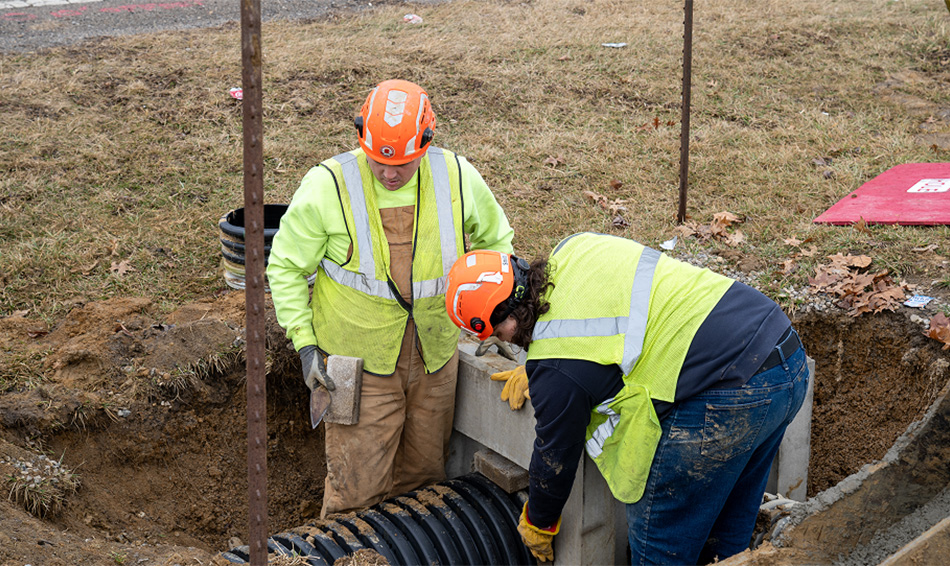
The Franklin County Board of Commissioners has appointed the County Engineer to serve as the County Drainage Engineer. This office oversees the maintenance and improvement of the county’s regional drainage systems, including the design, construction, and upkeep of ditches, pipes, and retention basins that were established through the petition process. We also coordinate stormwater compliance efforts and partner with local, state, and environmental agencies to address drainage issues and develop regional management plans.

What Makes Them Different
Franklin County Engineer
- Elected official
- Primary funding source through motor vehicle registration and gas user fees
- Maintains bridges, roads, and road drainage systems within the public right-of-way
Franklin County Drainage Engineer
- Appointed by the Franklin County Board of Commissioners
- Primary funding source through the Board of Commissioners’ General Fund
- Maintains, repairs, and replaces regional drainage systems and coordinates
- Franklin County’s stormwater environmental compliance
Petition Ditch Program
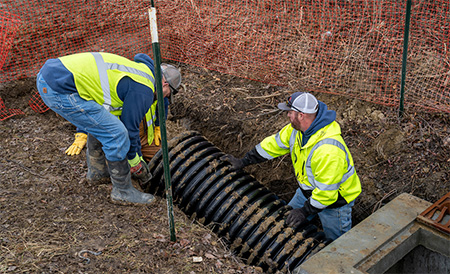 The County Drainage Engineer oversees the design, construction, and maintenance of drainage systems within the public right-of-way in unincorporated areas. This includes managing the county’s ditch petition process for improving drainage in these areas and the subdivision platting process for new developments. The costs associated with these improvements are assessed to the property owners within the petitioned areas. Currently, the county’s petition ditch inventory includes 94 miles of open ditches and 147 miles of closed (tiled) ditches.
However, the County Drainage Engineer is not responsible for stormwater management on private property. Property owners must manage their stormwater systems independently, though assistance may be available through the petition or platting processes mentioned above.
The County Drainage Engineer is not responsible for stormwater management on private property, but drainage assistance in unincorporated areas may be requested through the county’s ditch petition process, or, for new subdivisions, through the subdivision platting process. The cost of these improvements is then assessed to the property owners in the petitioned areas.
For More Information
Preventing Stormwater Pollution and Controlling Sediment and Erosion

Businesses
The Franklin County Engineer’s Office capital improvement projects are constructed in compliance with the National Pollutant Discharge Elimination System (NPDES), particularly the Ohio Environmental Protection Agency’s (EPA) Authorization for Stormwater Discharge Associated with Construction Activity, as regulated by the NPDES. Additional federal, state, and local regulations related to stormwater pollution also apply.
CONTRACTOR RESPONSIBILITIES
Permit and Notification Requirements: Contractors are required to co-sign the Ohio EPA permit and Notice of Intent (NOI) as mandated by the NPDES. The prime contractor is responsible for notifying subcontractors of the Ohio EPA requirements, ensuring they sign affidavits acknowledging these requirements, and providing copies to the Franklin County Engineer’s Office (FCEO) before any associated work begins.
Stormwater Pollution Prevention Plan (SWP3): Within 20 days of the construction contract award, the prime contractor must submit a Stormwater Pollution Prevention Plan (SWP3) to the FCEO for approval. This plan must be prepared by a professional with experience in the design and implementation of standard erosion and sediment controls and stormwater management practices for all phases of construction.
Best Management Practices (BMPs): The prime contractor must provide a detailed description of all BMPs and installation practices planned for the project. Any amendments to the SWP3, whether due to changes in design, construction, operation, or maintenance, must be submitted in writing to the FCEO, especially if these changes significantly affect the potential for pollutant discharge into Ohio’s waters.
Sediment and Erosion Control: The prime contractor is fully responsible for ensuring that no turbid discharge is released from the construction site. This includes all areas outside the designated work limits, such as locations where soil is stockpiled, excavated, or disposed of as fill. The prime contractor must file an NOI with the Ohio EPA for these off-project areas and provide copies to the FCEO
COUNTY ENGINEER OVERSIGHT
- Monitoring and Inspections: FCEO will closely monitor the implementation of the SWP3, with particular attention to the construction and maintenance of BMPs. Inspections of sediment and erosion controls will be conducted at least once every seven days and within 24 hours after any storm event resulting in more than half an inch of rain within a 24-hour period. If deficiencies are found, the prime contractor must make necessary repairs within 24 hours of notification or face liquidated damages and other penalties in accordance with Ohio Department of Transportation (ODOT) policies.
- Compliance and Enforcement: Our goal is to meet all Ohio EPA, ODOT, and local water pollution prevention standards for construction sites. The prime contractor must submit a description of the BMPs to be employed prior to the start of work. FCEO reserves the right to deny the implementation of any BMP deemed ineffective before or during construction activities.

Residents
Whether you’re caring for your yard, cleaning, or working on a home improvement project, there are lots of things you can do to help keep Franklin County’s water sources clean.
KEEP YOUR YARD CLEAN
- Pick up litter in your trash can area to prevent it from blowing into a nearby waterway and polluting our creeks.
- Keep lawn clippings away from gutters and storm drains. Clippings that end up in creeks decompose in the water and rob aquatic life of oxygen.
- Minimize the use of fertilizers and pesticides in your garden. If you must use them, choose less toxic alternatives. Make sure you apply in dry weather and water sparingly after use to prevent spreading.
- Dispose of animal waste properly by flushing it down the toilet or throwing it in a trash can.
MAINTAIN YOUR PARKING AREA AND GARAGE
- Properly store yard, household, and automotive chemicals in a cool, dry place without leaks. Make sure to properly dispose of household toxic waste.
- Clean parking areas with a broom instead of a hose. To clean up an auto leak on concrete, use kitty litter or other absorbent material to soak it up, then sweep and dispose of it properly.
- Recycle used oil, antifreeze, oil filters and other toxins at a household hazardous waste collection drive.
- Opt for commercial car washes instead of washing your own car, when possible. These businesses recycle the water and have ways to clean the runoff.
- Avoid using soap, or use as little as possible. Even biodegradable soaps don’t break down soon enough to avoid killing organisms in the creeks. Try to wash on gravel or grass. Dispose of extra soapy water in a sink or toilet.
TAKE CARE DURING HOME IMPROVEMENT PROJECTS
- Sweep, don’t rinse, concrete, aggregate, and other dust and waste materials for disposal in the garbage. Concrete mixes have chemicals that will poison creek life if rinsed down the gutter or driveway.
- Keep paint out of our creeks. Rinse any latex paint-covered brushes and rollers in the sink. Take paint thinner, solvents, and other chemicals to a household toxic disposal facility.
- Watch where you clean your grill. Avoid cleaning barbecues on paved areas that can be rinsed into gutters and creeks. Burnt food buildup is poisonous to animals, even in low concentrations.
Drainage Resources

STORMWATER DRAINAGE MANUAL
FRANKLIN COUNTY AND TOWNSHIP STORMWATER MANAGEMENT PROGRAM